

PLINTH is a raised pond with integrated filtration, pump, and fountain. A complete system that arrives ready to place. No excavation, no liner, no assembly. This guide compares the benefits of above-ground and in-ground ponds to help you decide which is right for your garden.
Above-Ground vs In-Ground Ponds
Choosing between an above-ground and in-ground pond depends on your space, budget, and how much disruption you're willing to take on. Both can support fish, planting, and clear water, but they differ significantly in how they get there.
INSTALLATION
An in-ground pond requires excavation, disposal of soil, liner installation, edge finishing, and usually a separate pump and filter setup. Most in-ground ponds need professional installation or significant DIY experience. The process typically takes several days to several weeks, depending on size and complexity.
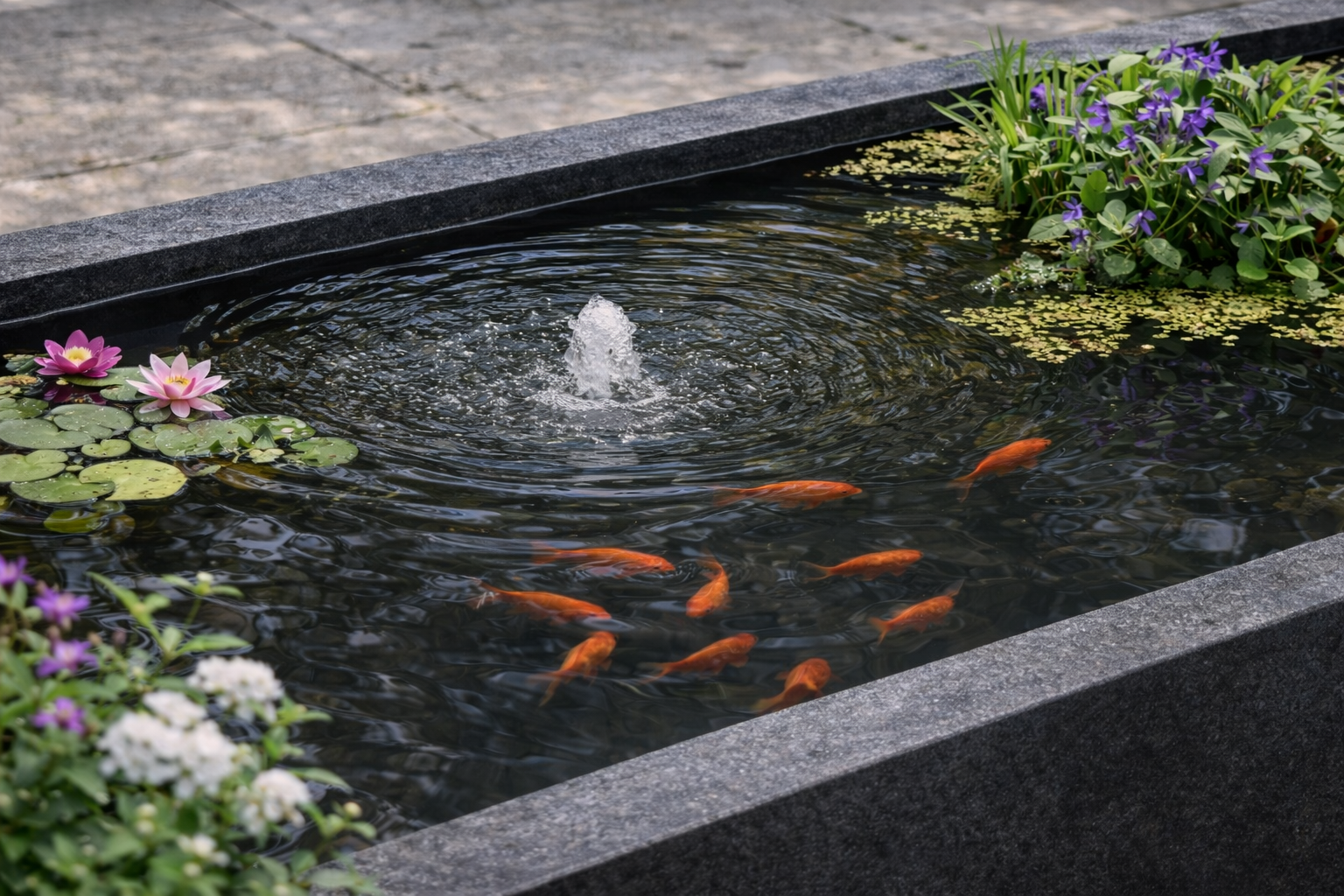
An above-ground or raised pond sits on an existing surface, paving, concrete, or reinforced decking. There is no digging, no groundwork, and no permanent alteration to the garden. A well-designed raised system can be positioned and running within a day of delivery.
COST
In-ground ponds vary enormously in cost. A basic DIY liner pond might start around £500–£1,000 for materials, but once you factor in excavation, a skip, edging, a pump, a filter, UV clarifier, and planting, most in-ground ponds land between £2,000 and £5,000 for a modest size. Larger or professionally installed ponds regularly exceed £8,000–£15,000.
A raised pond with integrated filtration typically falls between £1,500 and £3,500 depending on size and specification, with no additional costs for groundwork, liners, or separate filtration equipment.
MAINTENANCE
In-ground ponds are more exposed to ground-level debris. Leaves, soil run-off, grass clippings. which increases maintenance. Liner ponds may need periodic liner replacement, and accessing pumps and filters often means reaching into or below the water.
Raised ponds sit above ground level, reducing debris ingress. Systems with integrated filtration are designed to keep water clear with minimal intervention. Access to pumps and filters is typically easier because everything is contained within the structure.
SUITABILITY FOR UK GARDENS
In-ground ponds suit larger gardens where there is space to excavate and landscape around the edges. They work well as a natural, organic feature integrated into planting schemes.
Raised ponds suit smaller or more structured gardens, courtyards, patios, terraces, and urban spaces where digging is impractical or undesirable. They also suit families with young children, as the raised edge provides a natural barrier.
FISH AND PLANTING
Both types can support fish and aquatic planting, provided the depth, volume, and filtration are adequate. A minimum water depth of around 45cm is generally recommended for overwintering common coldwater fish in the UK.
WHICH SHOULD YOU CHOOSE?
If you have a large garden, enjoy landscaping projects, and want a naturalistic pond set into the ground, an in-ground pond may suit you.
If you want a clean, considered water feature that requires no excavation, no disruption, and minimal ongoing maintenance, a raised pond with integrated filtration is the more practical choice for most UK gardens.

You might also find these useful
Modern Garden Water Features
Raised Garden Pond Guide
Raised Pond vs Water Feature
Above-Ground vs In-Ground Ponds
Small Garden Water Feature Ideas
Contemporary Raised Pond Ideas
Modern Garden Pond Costs (UK)
Can You Keep Fish in a Raised Garden Pond?
Best Plants for a Raised Pond UK
Design Your Plinth
Raised Pond Lighting Ideas
How to Winterise a Raised Pond
Frequently Asked Questions
An above-ground (raised) pond sits on the surface without excavation. It is freestanding, portable, and can be placed on any firm, level surface such as a patio, deck, or compacted gravel. An in-ground pond requires digging a hole, lining it, and often involves professional installation. Raised ponds are generally quicker to install, easier to maintain, and safer for children and pets.
Yes. A raised pond is easier to access because you don't need to kneel or lean over ground level. Cleaning, plant care, and fish feeding are all more comfortable. Raised ponds with integrated filtration, like PLINTH, also simplify water quality management because the filtration, pump, and fountain are built into the unit.
As a guide, allow approximately 50–60 litres per small goldfish. A 200-litre raised pond suits 3–5 fish, a 350-litre pond suits 5–8 fish, and a 500-litre pond suits 8–12 fish. Start with fewer than the maximum and add gradually once the biological filtration has matured.
Yes. An above-ground pond with integrated filtration and adequate water volume (at least 200 litres) is suitable for goldfish and shubunkins. The raised height also makes fish more visible and easier to enjoy.
Generally no. Freestanding raised ponds that do not involve excavation, plumbing into mains water, or structural changes to your property do not require planning permission in the UK. However, if your property is listed or in a conservation area, it is worth checking with your local planning authority.
Water weighs 1kg per litre, so a 350-litre raised pond will weigh approximately 350kg of water plus the weight of the unit itself. PLINTH raised ponds range from approximately 200 to 500 litres depending on size. The surface must be firm and level — a patio, concrete base, or compacted gravel is ideal.
A raised pond is generally considered safer than an in-ground pond because the raised walls provide a barrier. Children can see into the water safely without leaning over ground level. Supervision is still recommended around any body of water.
Ready to choose yours?
The PLINTH Founding Collection is available now. Three sizes with integrated filtration, pump, and fountain. Free UK delivery.
Browse the Founding Collection →